


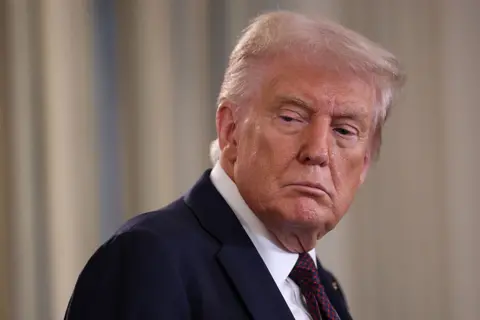
Our nation's Supreme Court kicks off its new term this Monday with a agenda already loaded with likely important legal matters that could determine the limits of Donald Trump's governmental control – and the prospect of further matters to come.
During the recent period after Trump came back to the executive branch, he has challenged the constraints of governmental control, independently implementing new policies, reducing federal budgets and personnel, and attempting to bring once self-governing institutions further within his purview.
Judicial Conflicts Concerning State Troops Mobilization
A recent developing court fight arises from the administration's moves to seize authority over state National Guard units and send them in urban areas where he alleges there is civil disturbance and escalating criminal activity – over the opposition of municipal leaders.
Within the state of Oregon, a federal judge has delivered directives preventing Trump's deployment of soldiers to that region. An appeals court is set to reconsider the move in the next few days.
"This is a land of legal principles, not martial law," Jurist the presiding judge, that the President appointed to the bench in his previous administration, stated in her latest ruling.
"Defendants have presented a series of arguments that, if upheld, endanger erasing the boundary between civil and armed forces government authority – to the detriment of this nation."
Shadow Docket Could Shape Defense Authority
Once the appellate court has its say, the justices may step in via its often termed "shadow docket", delivering a ruling that might restrict the President's authority to use the military on US soil – or provide him a wide discretion, for now temporarily.
These reviews have become a regular occurrence in recent times, as a greater number of the court members, in reply to urgent requests from the executive branch, has generally permitted the government's actions to move forward while court cases progress.
"An ongoing struggle between the justices and the district courts is going to be a driving force in the next docket," a legal scholar, a professor at the Chicago law school, stated at a meeting in recent weeks.
Objections Regarding Expedited Process
Justices' use on the shadow docket has been questioned by progressive academics and politicians as an inappropriate use of the legal oversight. Its rulings have often been short, offering limited justifications and providing lower-level judges with minimal instruction.
"The entire public should be alarmed by the Supreme Court's increasing use on its shadow docket to decide contentious and notable cases lacking the usual transparency – no comprehensive analysis, courtroom debates, or justification," Politician the New Jersey senator of the state stated previously.
"It additionally pushes the Court's considerations and rulings beyond public scrutiny and protects it from accountability."
Complete Proceedings Ahead
Over the next term, though, the justices is scheduled to confront questions of presidential power – along with other high-profile controversies – squarely, hearing public debates and providing comprehensive decisions on their substance.
"The court is not going to have the option to brief rulings that omit the rationale," stated Maya Sen, a expert at the Harvard University who focuses on the Supreme Court and US politics. "When the justices are planning to award expanded control to the administration they're will need to justify why."
Key Cases featured in the Schedule
Justices is presently planned to consider whether federal laws that bar the president from dismissing officials of bodies designed by the legislature to be autonomous from presidential influence undermine governmental prerogatives.
The justices will additionally consider appeals in an expedited review of the President's attempt to fire a Federal Reserve governor from her role as a member on the influential monetary authority – a case that might substantially expand the chief executive's power over national fiscal affairs.
The US – along with world economic system – is also a key focus as judicial officials will have a opportunity to rule on whether many of the administration's unilaterally imposed tariffs on foreign imports have sufficient legal authority or must be overturned.
Court members might additionally consider Trump's efforts to independently reduce public funds and terminate lower-level government employees, in addition to his assertive border and expulsion measures.
While the judiciary has yet to decided to consider the President's effort to end birthright citizenship for those given birth on {US soil|American territory|domestic grounds

